

Frequently asked questions
General
You can easily place your order with us online. On each product page, you will find an ‘Add’ button. By clicking it, the product is immediately added to your shopping cart. If you would like to continue shopping, simply choose ‘continue shopping’. By clicking the ‘Go to my shopping cart’ button, you can view all the products you have selected. If you have added too many or too few of a product to your shopping cart, you can of course still adjust this before finalizing your order. You can find detailed information about ordering and returns on this page.
Yes, absolutely. DUCQ has a large number of stores in the Netherlands where you can view the cookware. Please note that the assortment may vary by store. Of course, you can also order the cookware online and try it at home for 14 days. If the cookware does not meet your expectations, you can return it to us free of charge, provided it is unused and in its original packaging.
If you have a discount code or voucher and would like to use it for your order, you can enter it in the ‘Discount code’ field during checkout, after filling in your personal details. Please note that the code is case-sensitive and that any punctuation marks, such as hyphens, must also be entered exactly as shown. After entering the code, do not forget to click the ‘Apply’ button. You will then see in the order total whether the discount has been applied.
We measure the diameter across the top edge of the pan. This means that the base of the pan may be slightly narrower than the stated diameter.
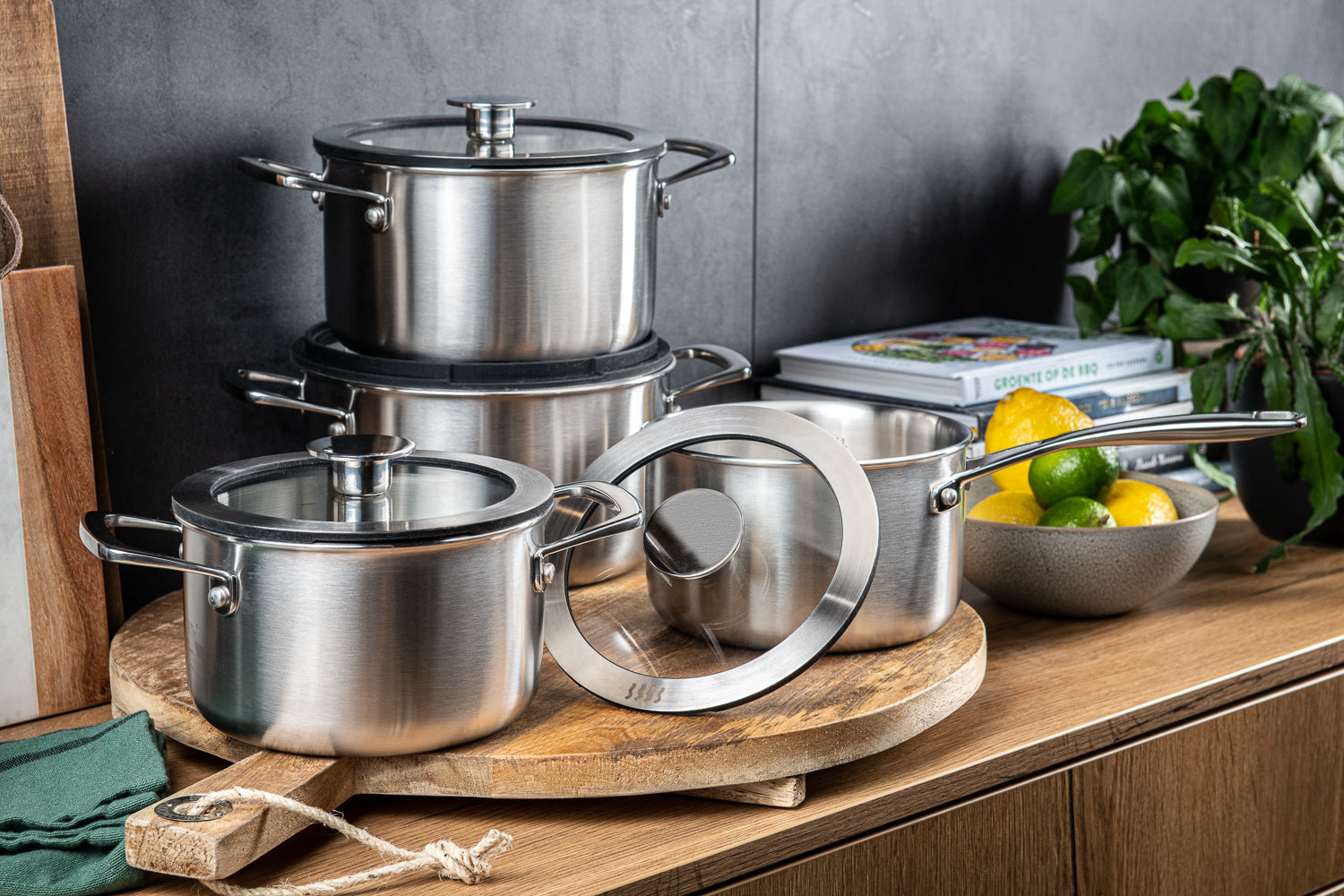
By using three layers (steel or copper and aluminum), the cookware heats evenly throughout. This is especially important for cookware with a non-stick coating, as it helps prevent vulnerable areas from forming in the coating. In addition, the three-layer construction improves heat conductivity, allowing the cookware to heat up more quickly and use energy more efficiently.
Naturally, they are made of cast iron, with an enamel coating on both the inside and outside of the pan. Cast iron is iron enriched with carbon, manganese, and silicon. It is produced by remelting raw iron with lime and coke (a specially processed form of coal), which is then poured into moulds. Enamel is molten glass that is very smooth (hygienic), extremely hard, non-flammable, and durable. Our cookware features an anthracite grey enamel coating on both the inside and outside, which helps prevent discolouration.
Because cast iron is a heavy material, and that comes with several advantages. A cast iron pan retains heat much longer than other pans, and the heavy lid ensures that no moisture can escape. This helps keep moisture inside the pan, which is especially important when preparing stews. Another advantage of cast iron is that it cannot warp, meaning the base will always remain flat.
Cooking & Use
DUCQ cookware is specially designed for use on induction, but DUCQ cookware is suitable for all heat sources: gas, induction, ceramic and electric. However, with prolonged use on gas, and especially at high temperatures, the bottoms may bulge slightly.
Certainly. All DUCQ cookware can be placed directly in the oven. The large Dutch oven, in particular, is ideal for preparing large cuts of meat or fish.
Yes, they can, but please keep in mind that the silicone ring may dry out more quickly and become damaged as a result. Make sure the oven temperature does not exceed 250 degrees Celsius.
The outer layer of the DUCQ copper cookware is made of copper, with the base made of induction steel, making the cookware suitable for induction. The composition of the pans also ensures that the base remains flat when heated and does not warp.
The lids of our copper cookware are made of stainless steel (SS). The reason they are not made of copper is that the food to be prepared should not come into direct contact with the copper.
The handle and side handles of the DUCQ cookware will not get hot, as long as you place the pan in the centre of a heat source of the correct size. The long handle is hollow, and because it is attached to the pan at only two small contact points, it hardly heats up. The exception is the cast iron pans, whose handles do get hot.
DUCQ cookware includes both cookware with and without a non-stick coating. The main advantage of a frying pan with a ceramic non-stick coating is everyday convenience. Cookware with a ceramic coating requires little fat for cooking and are easy to clean. And of course, the ceramic coating is completely PFAS-free.
Professional chefs generally prefer a pan without a non-stick coating when cooking a good piece of meat, as it allows the meat to sear more quickly.
The main advantage is that you can sear meat more quickly; professional chefs therefore often use a pan without a non-stick coating. For delicate ingredients with a soft structure, such as fish or eggs, a pan with a non-stick coating is easier to use. DUCQ cookware offers both options, depending on the cooking result you want to achieve.
No, if you place the pan in the centre of a heat source of the correct size, the handle or side handle will not get hot. This is because it only makes contact with the pan at two small points. When used correctly (positioned in the centre of the right heat source), you can hold it without an oven mitt. As a reminder: if you place the pan in the oven, the handle or grip will of course become hot.
Yes, it can. At temperatures above 220 degrees Celsius, chipping may occur, which can cause the ceramic coating to crack or break. Please be aware that on high-quality cooktops, 220 degrees can be reached within just a few minutes; on full power, temperatures can even rise to around 400–500 degrees. The ceramic coating is not designed to withstand such heat. Stainless steel pans may become discoloured at these temperatures. Repeated overheating can also lead to irreversible deformation of the pan.
No, that is not necessary, as it is coated with enamel, meaning the cookware is ready to use straight away. However, we do recommend rinsing it before first use after unpacking.
These “drops” ensure continuous self-basting during cooking: evaporated moisture condenses on the lid and drips evenly back into the pan. This helps prevent the dish from drying out and keeps all the flavour inside the cookware. This makes a cast iron pan an ideal pot for slow cooking and stewing.
Because this allows you to truly grill your meat, fish, or vegetables. Thanks to these high ridges (5 mm instead of the 2.5 mm found in most grill pans), you can quickly sear the food, which creates that distinctive grilled flavour. With lower ridges, your food may start to stew instead of grill, resulting in a loss of that authentic grill taste.
Health & Safety
Absolutely. DUCQ values convenience, but also pays close attention to health. That is why all DUCQ non-stick cookware is equipped with a strong, durable, ceramic, PFAS-free non-stick coating.
No, certainly not. Each pan has a stainless steel inner layer. This is completely sealed at the edges and even folded over for extra protection. This prevents food from coming into direct contact with aluminum or copper.
Maintenance & cleaning
No, preferably not. It's really better to handwash copper cookware.
No, because the edges of the pan do not have an enamel layer, rust spots can form there when used in the dishwasher. Cast iron cookware is therefore better washed by hand.
Yes, absolutely! However, it is best to dry the pans with a soft cloth immediately after the programme has finished to prevent streaks or water spots from forming. Please note that dishwashing may cause the pans to become dull more quickly over time.
You can clean these pans in the dishwasher, but a non-stick pan will last longer if you wash it by hand. Do not use abrasive cleaners or scourers to prevent scratches.
To keep DUCQ cookware scratch-free, it is best to use wooden or silicone utensils. A knife or fork can be used, but metal on metal will always cause scratches. Although this is mainly cosmetic, it does not affect the performance of the pan. Good to know: copper is a relatively soft precious metal, so even with daily use, small scratches may occur on the pan over time.
Small spots on the bottom of the DUCQ cookware may appear after every use (including the first use). These are often limescale or mineral deposits. The latter can come from starch residues, for example from potatoes or pasta, and the amount of limescale depends on the hardness of the water.
Our 3-ply DUCQ cookware conducts heat very efficiently, which creates the “perfect” conditions for limescale to settle on the bottom. Fortunately, such stains can easily be removed with a soft cloth and a little vinegar.
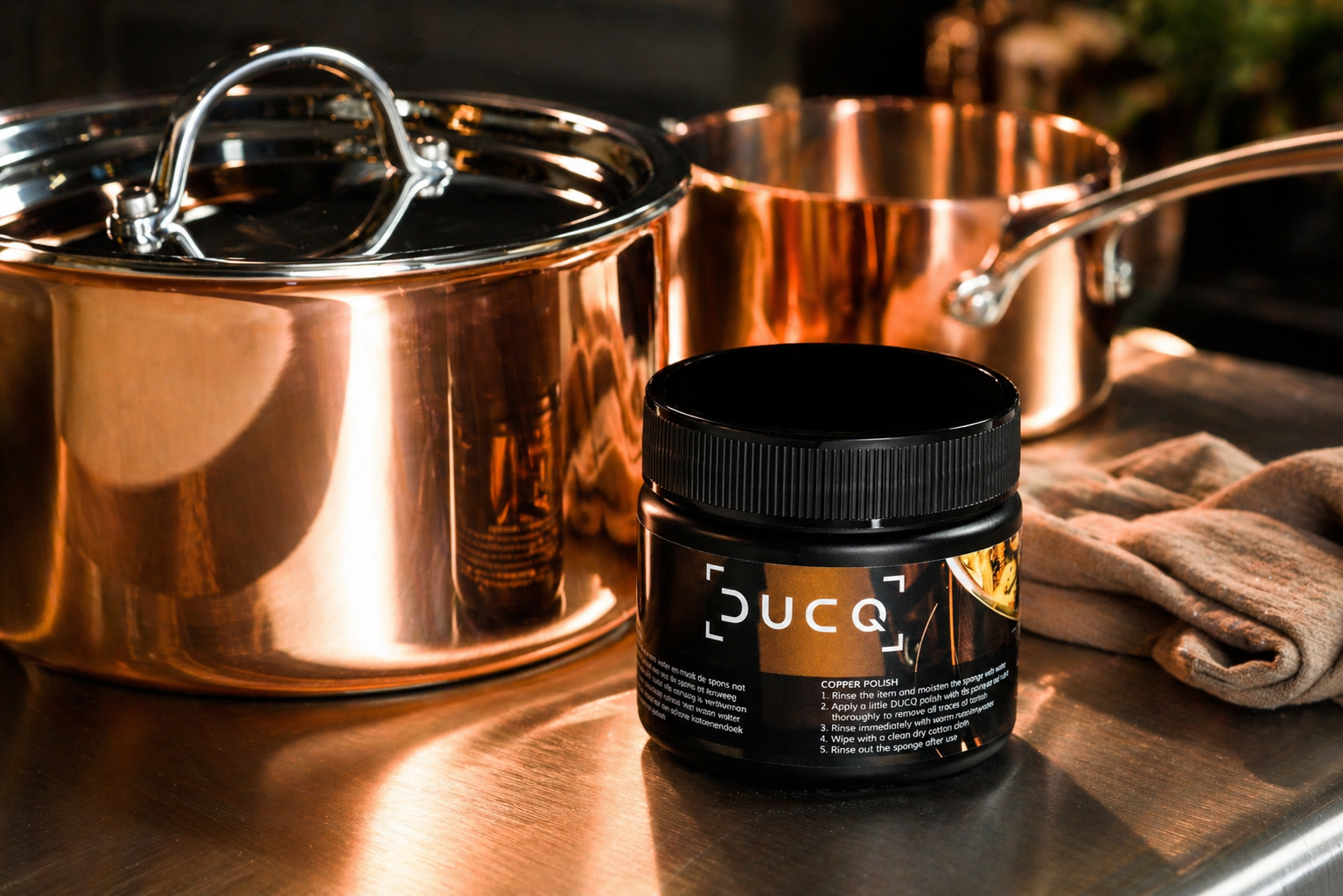
This starts already when washing the pan directly after use; it is best to do this with hot water and a small amount of dishwashing liquid. To prevent streaks and maintain the shine, dry the pan afterwards with a soft cloth. Please note that copper will naturally develop a patina and slight discolouration over time, this is also part of the charm of copper, isn’t it? If you still prefer a shiny copper pan, polish it regularly with DUCQ copper polish.
Discolouration of stainless steel is normal and is caused by overheating. Therefore, avoid heating the pan too much to prevent discolouration. If it does happen, it can easily be removed by polishing with a soft cloth and a little vinegar.
During cooking, grease residues can stick to the pan. This can create a brownish haze, especially on the bottom. No need to worry. With some stainless steel cleaner, the pan can easily be restored to a shiny finish. Such cleaners are commonly available in supermarkets.